
Blog Detail
How to Choose the Right kVA Rating for Your Business
Posted On 15 Mar 2026
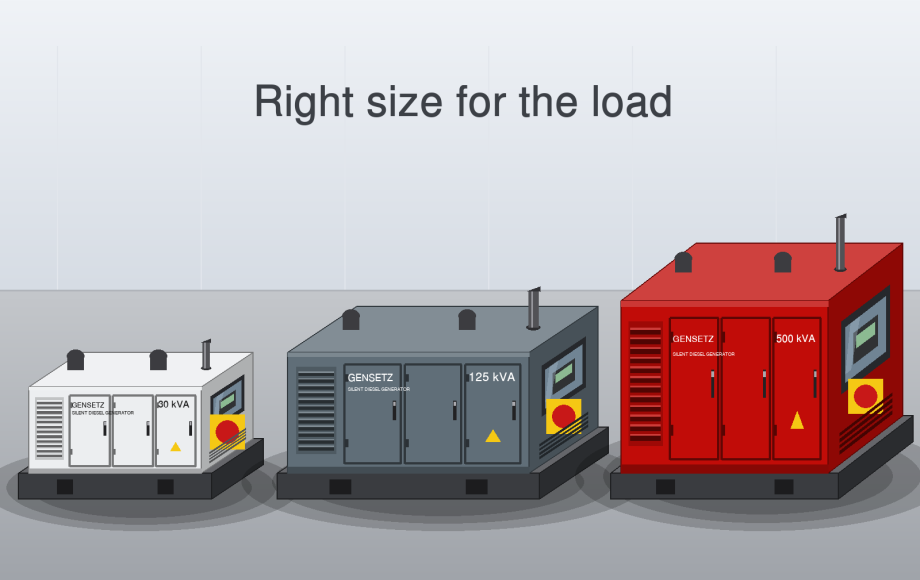
Buying a generator that is too small leads to tripping, voltage dips and a set that is constantly overloaded. Buying one that is far too large wastes capital and fuel, and a diesel engine that runs at very light load for long periods does not age well. Getting the kVA rating right is the single most important decision when you buy a used diesel generator. This guide walks through a practical sizing approach for Indian businesses.
kVA and kW: what the rating actually means
Generators in India are usually sold by their kVA (apparent power) rating, while most of your equipment is rated in kW (real power). The two are linked by the power factor. Diesel generator sets are normally rated at a power factor of 0.8, so:
- kW = kVA × 0.8 — a 125 kVA set delivers about 100 kW.
- kVA = kW ÷ 0.8 — a 60 kW load needs at least 75 kVA before any margin.
Always check the nameplate of the set you are considering: it shows the kVA, kW, voltage, frequency and power factor the unit was built for.
Step 1: List every load you want to back up
Walk through the site with your electrician and write down each load that must run on the generator. For each item note its running power (kW), whether it is single-phase or three-phase, and whether it has a motor.
- Lighting, fans, computers, servers and UPS systems
- Air conditioners, chillers and cold rooms
- Pumps, compressors, lifts and conveyors
- Production machines, welding sets and furnaces
- Medical equipment, if you are sizing for a hospital or clinic
Decide early whether the generator must carry the whole site or only essential loads. Backing up only critical circuits can bring the required rating down considerably.
Step 2: Allow for motor starting
Motors draw several times their running current for a few seconds while starting. A generator that comfortably carries the running load can still dip badly or trip when a large pump or compressor starts. The starting method matters a great deal: direct-on-line (DOL) starting is the most demanding, while star-delta starters, soft starters and variable frequency drives (VFDs) reduce the starting surge.
Where possible, arrange for the largest motors to start one after another rather than together. Your electrical consultant can calculate the worst-case starting step and check it against the generator's transient performance.
Step 3: Add sensible headroom
A generator should not be sized to run at its full rating all the time. Many engineers aim for the normal running load to sit comfortably within the rating — often somewhere around 60–80% — leaving room for starting surges, ageing and future expansion. At the other extreme, avoid a set that will spend most of its life at very light load, as this can lead to incomplete combustion and carbon build-up (often called wet stacking).
Step 4: Match the duty: standby, prime or continuous
- Standby — for backup during grid outages, with limited annual running hours.
- Prime — for sites where the generator is the main source of power and runs for long, variable-load periods.
- Continuous — for constant load with no time limit.
These ratings are defined in the manufacturer's documentation (commonly with reference to ISO 8528). The same engine can carry a lower rating in prime or continuous duty than in standby, so confirm which rating the seller is quoting.
Step 5: Consider site conditions
High ambient temperatures, high altitude and poor ventilation reduce the power an engine can deliver. Manufacturers publish derating guidance for these conditions. If your site is hot, enclosed or at altitude, ask for the derating data for the specific engine model.
A simple worked example
Suppose an office-cum-workshop wants to back up the following (illustrative figures only):
- Lighting, computers and networking: 12 kW
- Air conditioning: 20 kW
- Two 7.5 kW pumps with star-delta starters: 15 kW
Total running load is 47 kW, which is about 59 kVA at 0.8 power factor. Adding headroom so the running load sits around 70–75% of the rating points to roughly 80 kVA, so a common rating such as 82.5 kVA would be a reasonable starting point — subject to your consultant confirming that the pump starting steps are acceptable.
Quick checklist before you enquire
- Total running load in kW and required kVA at 0.8 power factor
- Largest motor and its starting method
- Single-phase or three-phase supply requirement
- Standby or prime duty, and expected running hours per year
- Whether you need an AMF panel or synchronisation with another set
- Space, ventilation, noise and fuel storage at the installation site
With these details ready, use the Browse by Capacity filters on GENSETZ to shortlist suitable sets and send clear, specific enquiries to sellers. For critical installations, always have a qualified electrical engineer confirm the final sizing.
Related post
Checklist for Inspecting a Used Diesel Generator
A well-maintained used diesel generator can give years of dependable service at a fraction of t...
14 May 2026
Understanding Running Hours, Overhauls and Load Tests
When buyers compare used gensets, the first number they usually ask for is the running hours. H...
13 May 2026
AMF Panels and Generator Synchronisation Explained
Many used generator listings mention an "AMF panel" or a "synchronising panel". Both add real v...
12 May 2026
CPCB IV+ Emission Norms: What They Mean for Used Generators
India's move to tighter emission norms for diesel generator sets has changed the new-genset mar...
10 May 2025